Juri Velt moves between rural regions and cities, as well as between a writing- and a material-based practice. Trained as an architect and navigating life as a chronically ill person, their works deal with the question of “how to live together”— with a focus on companionship and other forms of resistance. Their recent works connect these interests to the climate crisis, the landscape(s) of thought and matter we find ourselves in, and the language(s) we have available to navigate the present.
> The signs are collapsing, and no longer certain
> Companions / Weggefährten:innen
> Den Hund halten
> Mein Knochen hat ein Ei gelegt oder: Ich denke darüber nach, wie du mich zeigen sollst
> Roaming Rumours of Resistance
Publications (excerpt):
> Book — Tender and Toxic Tales published by dpr Barclona (look inside)
> Text [dog] — Volume Magazine #66
> Book — The signs are collapsing, and no longer certain published by Sandberg Instituut x Space Issues
> Blog — Die Zeichen zerbrechen, und sind nicht mehr sicher – Über Sprache in sich wandelnden Landschaften published by klimakultur.tirol
Coming up:
wenn wir sprechen, gehen räume auf
Gruppenaustellung (group exhibition)
Künstler*innenhaus Büchsenhausen, Innsbruck
Eröffnung: 03.12.2026
stern*
Werkstatt Kultur, Graz
28. + 29.11.2026
Seasonal Greet(dings)
Gruppenausstellung (group exhibition)
Design in Gesellschaft, Wien
Eröffnung: 26.11.2026
Recently:
Förderpreis für Zeitgenössische Kunst, Land Tirol, 2025
> hello@jurivelt.xyz
> @jurivelt.xyz
> @ceramic.companions
v
v
v
v
v
v


More Fotos + Info on the toponyms documented here
On Toponyms
We call many places by name—cities, quarters, bridges, houses. Most of the time, you can read these names on maps and signs. We also often carry other place names on our tongues, ones not part of official records but engraved into a local language. Place names—also called toponyms—offer a way to refer to a graspable unit of space. And this space can be a city, or it can be a field you pass while riding your bike.
Giving parts of a landscape a name is a practice rooted in local knowledge produced by being with and working with(in) the landscape. The words a toponym consists of reflect the specific feature(s) that define the space itself—or defined it at the time the name was given. This feature can be visual: a type of soil and thus a specific vegetation, a body of water in an odd form, a rock formation looking like a figure, a building resembling a cooking utensil, a crooked crossing of streets. It can be a lone tree, a funny fountain, a radio tower. Beyond describing what is visible, some toponyms refer to what happens in a landscape: an area of frequent avalanches, a cyclically flooded field, a route of a wildfire. Some toponyms might also refer to a type of ownership, a form of land reclamation, a strategy of deforestation, or similar specific practices—thus not predominantly reflecting the physical but rather the historical and social layers of a place. By further following the roots of a word to its origin, they can inform us how a landscape was seen, used, and understood at a specific time.
The Tales They Can Tell
Toponyms are a way how the landscape becomes language, and this language can translate a landscape back into our sensory understanding of the world. They inform us about what a place experienced—how it sounded, how it smelled, how moist, how dry, how exclusive, how busy it was. (1) They tell a story, provoke an image, draw attention to a sensation. (2) Their origin is sometimes hidden underneath layers of language, overgrown greenery, or dust. (3) At times, it is less coded, and what the toponym tells of is still visible, sensible, or might become so through a slight shift in perspective or a little twist of tongue. Toponyms facilitate orientation and support navigation, not only for the initiated but often also for the ones observing. (4) They make a landscape readable and offer connections to the knowledge written into it. (5) And even if the meaning stays obscure, being able to call a place a name makes it part of one’s map. (6) Toponyms make a landscape grow with their language—not in size, but in detail.
This happens not only on a visual level but also by adding layers to the understanding of a place, its past and its possible futures. Toponyms also talk about (or even to) the present. What of its name-giving features is still present? What is sensible now? And what if the Lahnbach (“stream of stone and slush”) brings only crumbly dust?
Toponyms as Tools
Landscapes are dynamic, and so is language—some toponyms fade away, and others are introduced. Given our current challenges, one might question whether we have the language at hand to navigate the altered world ours is becoming. Amitav Ghosh, in Uncanny and Improbable Events (London: Penguin Books, 2021), argues that “lying at the heart of the climate crisis” is an “imaginative and cultural failure, (…) coming in parts from the complexities of the technical language that serves as our primary window to climate change”. Facing the climate catastrophe and multiple other crises, our landscapes will soon look, behave, and consequently be used differently. Maybe then, toponyms disappear with their landscapes. Maybe they stay and remind us of things long gone. Maybe they will rapidly change, too. Maybe there already are contemporary toponyms to navigate a landscape of uncanny change.
A Landscape, Not a Blandscape
A landscape is never a given thing; our perception of it depends on many factors. Toponyms tell of the relationships that are made with a landscape—they show what is considered urgent or important, what is ‘worth a name.’ Naming places helps avoid them slipping off into abstract space—to become a ‘blandscape’, a term coined (amongst others) by Robert Macfarlane to describe a landscape understood in large, generic units like field, valley, woods. In such a blandspace, features do not disappear but become unnamed and, through that, unseen. Language deficits lead to attention deficit, with the lack of an intimate connection and the lack of a specific language reinforcing each other. And if a landscape becomes undescribed and therefore unseen, it becomes more vulnerable to misuse, to exploitation, to being defined by its use value only.
If we understand language to have the power to situate us, to ground us where we are, then, by making us notice what is around us, toponyms situate us in a landscape and thus become an important tool to stay in (or regain a) close connection to changing landscapes. Bringing what is there into our sensorial system through our tongues allows us to attune to what is, and to talk about it, too. And then, the better you come to know a thing, the more you want to care for it. Language, and with it, toponyms, and its ability to notice, name, and situate, is a tool for caring and defending what is worth defending.


(...)


Tender and Toxic Tales explores potential scenarios emerging with the disappearance of a segment of society in a mountain town. Three tales unfold in the voids left by its departure, unravelling the social and architectural repercussions of its absence. The stories bear witness to the use of the landscape (which holds a history of silver and gravel mining) and its consequences, whilst being interrupted by a choir that speaks in tongues both ancient and new, murmuring fragments of forgotten tales and offering glimpses of alternative perspectives.
One day, all those who have always stayed disappear—and with them, entrenched thoughts and ingrained habits. And as they leave so much space and so many things behind for those who return (often originally just visiting), they create a network of shared goods and common grounds, re-establishing old commons which are still visible in today’s urban structure.
One day, all the children disappear, and a city thus deprived of its future becomes a city of fortresses, and with everything that is found, higher and higher fences are built.
One day, everyone who is building or wants to build a new house disappears. As a result, those who remain claim the spaces that were already there and unused.
Toponyms (field names) (see also: The signs are collapsing, and no longer certain) anchor the stories within the same topographical landscape and reveal the varying effects of the remaining/evolving mental landscape. Dialect words complement the languages of the voices in the chorus, which consists of stones, winds, words, and weather.
Originally a work consisting of postcards and letters, and performed as a reading (while walking across a map drawn on the floor)—the ideas took shape in a book and were published by dpr Barcelona, resulting from the LINA (European Architecture Platform) Writing Award 2023.
< back


Below: Bookmark/Postcard designed by Jan Egbers and Goy Tung


I make a sound with my mouth, this specific kind of click with the tongue rolled back, pressed onto the palate, and quickly released. As a response, a head lifts. The dog stands up, every step towards me a slow stretch. I say Good morning, squat down to put the head through a collar, a movement followed by a mechanical click of attaching the leash. I stand up and touch my pockets. Left: keys, phone. Right: treats, small plastic bags. Our city map I carry in my head. I open the door, and with the movement of an arm, I invite the dog to go outside first.
BEFORE WE LEAVE
Moving through the city in conversation with the dog, I reconstruct my understanding of the environment. I enter a landscape of another, where we meet dangerous plastic bags, stairs bringing joy when quickly jumped up or down, and small mammals I hopefully see before they meet the dog’s teeth. I am an architect, and walking with the dog is part of my spatial practice. Through it, I add layers to my map of the city, not only informed by my strategies of navigating it but extended by observations that go beyond my own body.
LET’S GO
We exit onto a street in Vienna’s 3rd district. It is the early hours of a day already bright. Passing parking cars and trees growing out of brown circles between the grey of the street, we walk ahead until I see a sign: a white letter, a capitalised U surrounded by a bright blue. We enter the metro station. While I figure out the connection we will take, I hold the leash of the dog short.
A SHORT STOP (SCHLOSS SCHÖNBRUNN)
We are in a symmetrical garden, and I know we should not be here. The dog does not know that, the dog did not see the signs at the entry. I try to move through the space as if I, too, am not aware of this transgression of a border made of bold black letters and pictograms and walk with a confidence I copy from the dog. It is a strolling way of moving, following observation after observation. The dog sniffs here and there; I look there and here. We move on gravel that is part of a layout of what looks like a star from above. For us, it is a path along a line of trees cut to have edges. Somebody whistles, and the dog turns around. I try not to, but then I hear words, and I do look, too. A body in a uniform is approaching us, saying Dogs forbidden here! And Can’t you read!, I answer Oh, sorry and No, I was not aware, please excuse… and walk off, now in another way of moving: more focused and holding the leash close. Another whistle makes me stop and turn around again. The closest exit is there!, a finger points into the opposite direction. My eyes follow the gesture while the dog starts to sniff the gravel again. I soften the grip on the leash and let the dog do. The man in the uniform stands there looking at us. He looks at the dog, at me, at the dog, the hand still stuck in the air. The dog is done, lifts the head. I start to move and we walk away into the gesture. The man lowers his hand, turns around, and tends to a branch of a tree. The castle behind the fence, the fence around the garden, and the pointed finger of the gardener are all gestures of a similar narrative.
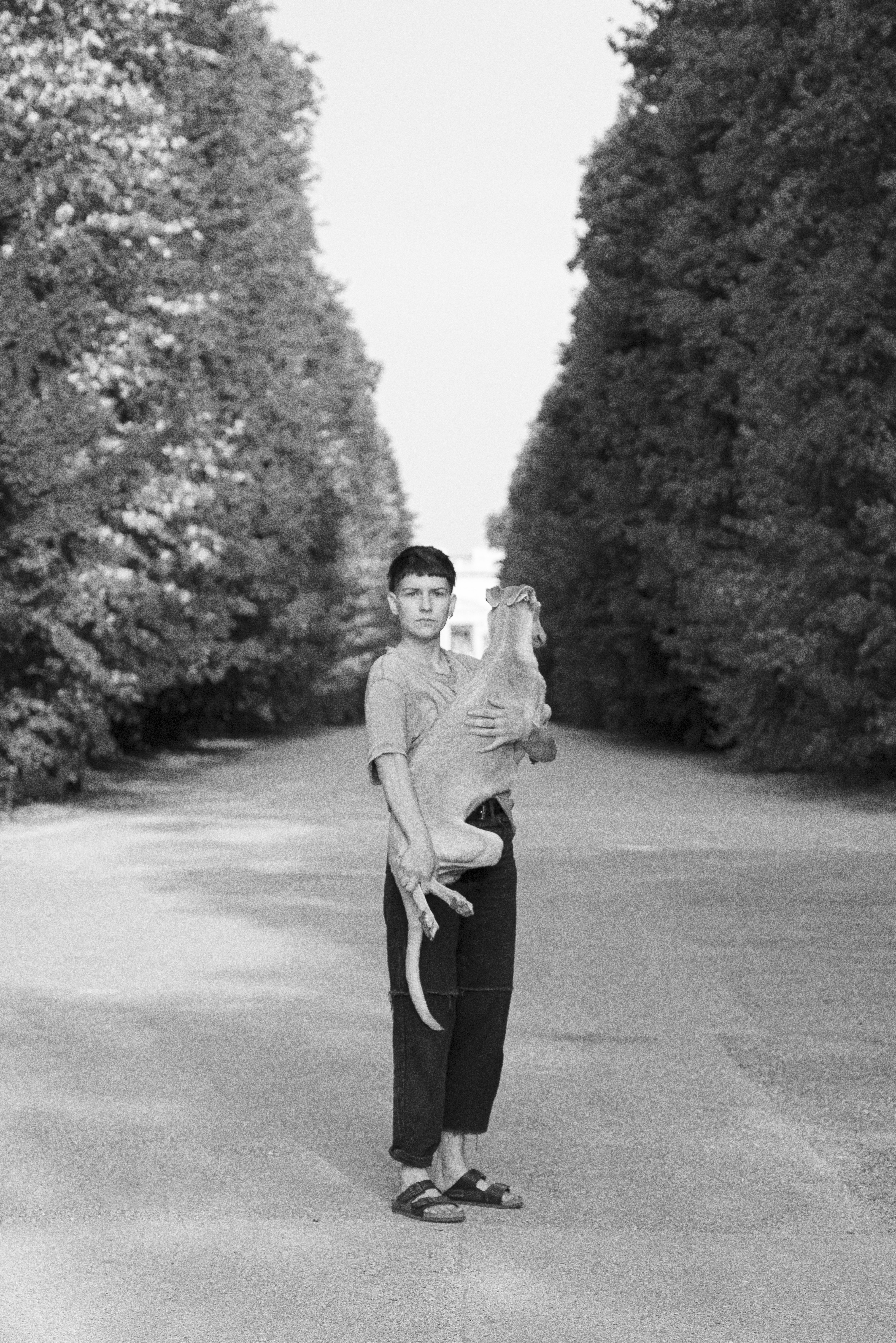
A WALK ALONG WATER (DONAUKANAL)
We walk along a stream of water without getting close to it. The canal runs through the city, the water it contains unruffled and tamed. Left and right of it walkways similar to streets, even grey glimmering in the midday sun. I touch the ground with one whole hand and start to count One – Two – Three – Four – Five – Six – Seven and stop. If I can count this far with my skin on the street, it is safe for the dog’s paws, too. We continue our walk next to others by foot or by bike, most of them moving faster than us. Between them, the dog runs without a leash. From time to time, I ask the dog to come closer to me again. Suspicious of the excited sniffs of the dog and human’s ideas, I fear there might be pizza or rat poison hidden in the occasional patches of greenery. The dog’s nose now follows something invisible to my eyes, the black of the nose in a zigzag in the middle of the grey of the street. Suddenly, the movement stops; the dog looks up, squats down, and pees. Now, I see something too: multiple lines running towards my feet, the grey darkening underneath the liquid. I step aside and think I also need to pee. I know I will need to cross the canal to access a public toilet, and I know it smells like pee under the next bridge. I also know the pee there is not from a body like mine or a body like the dog’s.
A MEMORY IN THE MIDDLE OF A STREET
I remember the time when the dog would only pee in the middle of the street. It was at a time when the dog was still afraid of houses, freshly coming from another country’s streets. When we would cross from one side to the other, right in the middle the dog would stop, squat, and pee. I found myself standing there too, waiting for the dog to finish, with cars waiting in front of us. The people in the cars were often angry, if at me or the dog, I could not say. It felt irrelevant anyway. I started to shrink my shoulders, thinking These are our streets, too.
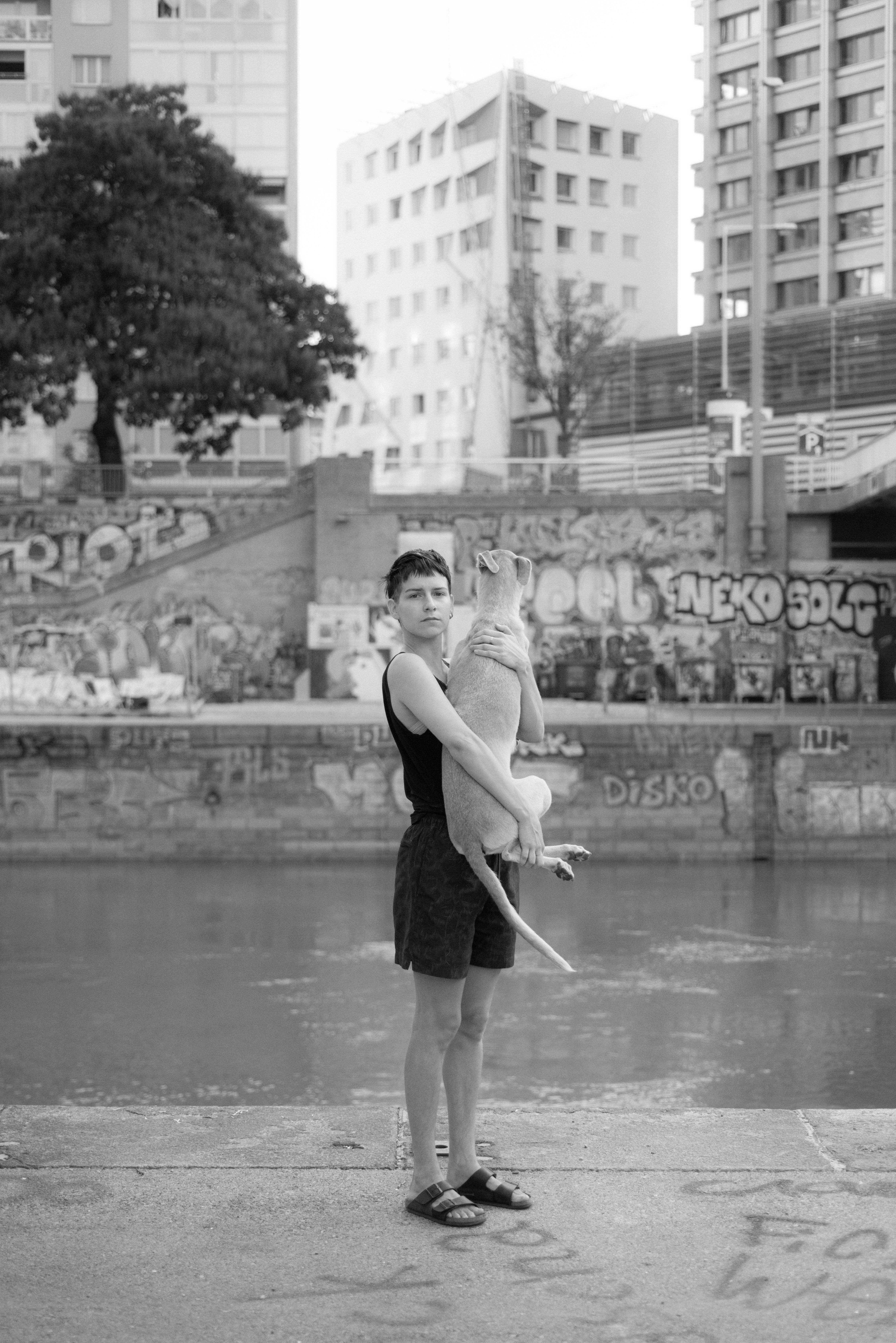
A THEMEPARK OF GLASS AND CONCRETE (ALTE WU / ALTHANGRUND)
Already for quite some time, we walk alongside what feels more like a spaceship than a building. On one end, a public transport station with an office building above, it transitions into a university building above a railway freight station. The offices and universities are almost entirely gone, but their architecture stays, stuck in their time. We follow facades replicating the same elements repeatedly (mirrored glass, metal grids, exposed aggregate concrete slabs) on its various layers, sometimes next to us, sometimes above, sometimes below. Climbing up the most generous of its stairs, we arrive at a level that feels like another kind of ground, while it is also a roof. We are standing in front of an entrance with six doors. Signs are pointing in various directions (-> UZA1 / UZA 2, <- WUW), offering ways to navigate between the buildings. Looking around, making sure we are alone, there is the click of unleashing the dog. I will not follow the signs; I will follow the dog. We turn around corners, go up and down stairs, and discover a landscape that is a building. I watch the dog run circles around a ventilation shaft. I catch the dog around corners waiting for me to catch up, the body positioned in a proposed direction of where to go next. I do not understand the layout, the connections of bridges, tunnels and platforms. But on our visits, the dog often leads me to similar moments, to what seems to be favourite elements to run around or jump on.
Following the dog through this megastructure of a future that is not there, I feel like walking through a Sci-Fi novel. The dog, a guide in its landscape, shows how the structure can be used and what senses the dog possesses to use for orientation. The offered world is mundane enough for me to still walk in it without mind or body acrobatics, yet foreign enough to make me wonder about all the ways space could be - and already is - inhabited and experienced beyond my understanding of it, beyond what I can access. I lie down between high dry grass, surrounded by windows that are mirrors. The dog sits next to me. It feels like together we hack the idea of the building’s purpose. We are rewriting its narrative, to include it on the map of the dog and me. Its corners are already inhabited by others, too. I see a mouse crossing the path (from a green over grey to another kind of green), and a rat running along a handrail. I feel an insect on my knee. The facade still reflects the last bits of sun. I hear something I cannot place. I call the dog to come even closer and sit back up. A mechanical click follows. The leash is back on, and we leave.
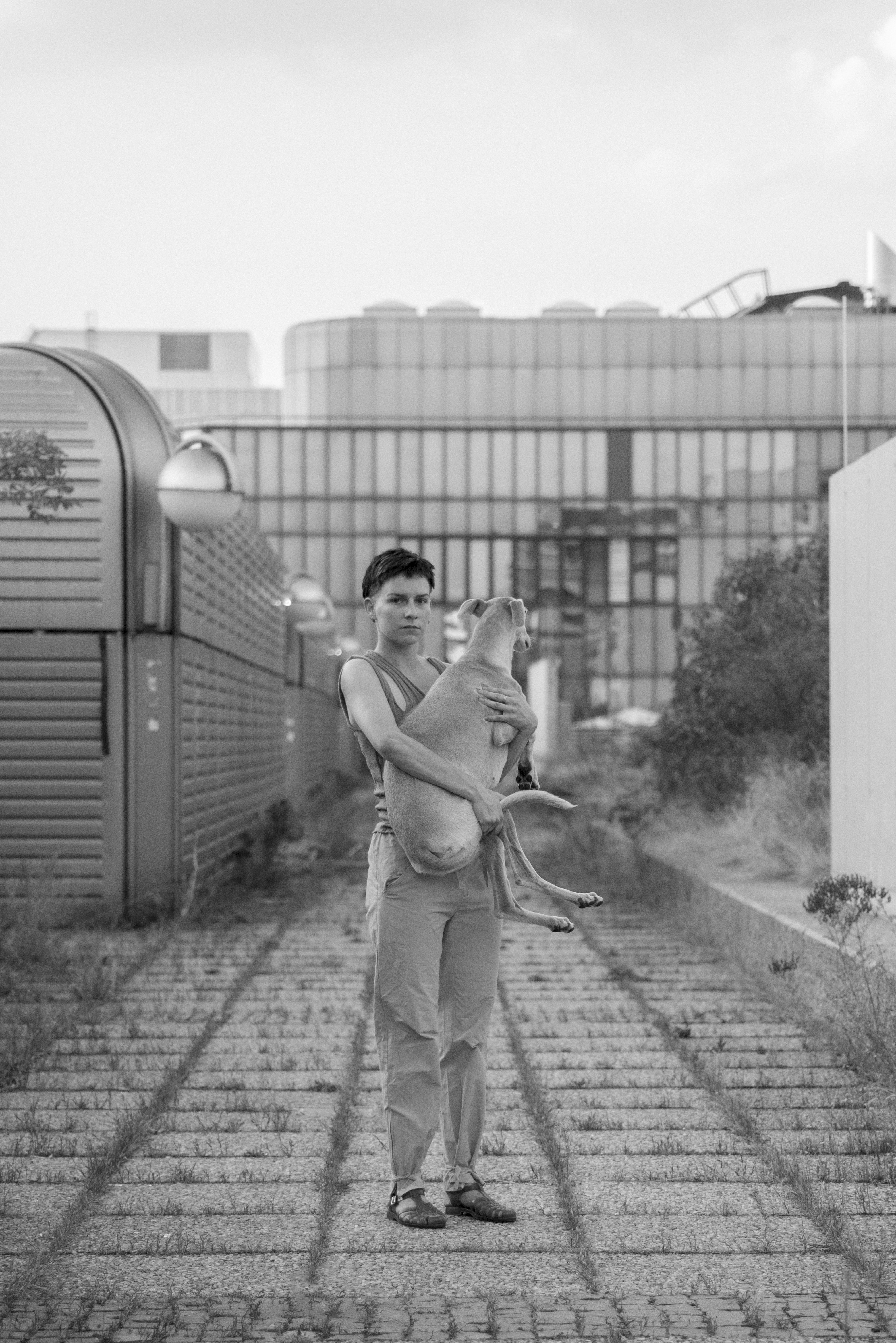
GOOD NIGHT, PRETTY
Walking back towards the metro station, along the straight long street next to the megastructure, somebody calls from behind. The person also makes clicks with the tongue, they sound like the one I make, too, and the dog turns around. Hey, so pretty, he says and it is unclear if it’s addressed to me or the dog. I stop underneath the next street light, and do not respond. I am already part of another kind of conversation, one between the dog and me and the city. He passes us, and we wait in the light until he is out of view. The dog pees at the light pole, and we continue our way.
published 2024 in VOLUME MAG #66 —
THE GUIDE TO DESIGNING WITH ANIMALS, PLANTS AND OTHER CRITTERS
as [dog] by Juri VeltThe signs are collapsing, and no longer certain
In “The signs are collapsing, and no longer certain”, Juri Velt explores the potentiality of language to shape our sense of and sensibility towards changing landscapes through toponyms—names of small geographical units defined by a specific feature, connected to a past or present moment of the place.
Toponyms hold information and the potential to transmit the knowledge they carry, informing us about what the landscape experienced.
Exemplified through the topography of the Austrian Alps, “the signs are collapsing, and no longer certain” poses the question of what toponyms will tell us in the substantially altered world ours is currently becoming—when, for example, the Lahnbach (“slush-stream”) only carries crumbly dust.
Photographs and text document Juri Velt’s interventions in the city of Schwaz, Austria: Signs made of unburnt clay with toponyms written on them, mounted on metal poles. The toponym signs are understood as being traces themselves, slowly dissolving over time, leaving behind metal brackets as a record of their existence.
Mehr lesen: Blogbeitrag auf klimakultur.tirol (GER)
Published via SPACE ISSUES x SOMETHING FANTASTIC (book) and KOOZARCH (excerpt of the essay)
An essay by Ann Lee Benedict on the work, published in; Sandberg Instituut Graduation Exhibition 2023 Publication, titled Perpetual Stew
> back
00/00/2023
![]()
![]()
Haag
Sign, unburnt clay Bracket, aluminium 12,5 cm x 50 cm May 2023
Haag is a toponym referring to a piece of land enclosed by a living hedge, often with a meager farmyard. A living hedge typically consists of greenery with thorns; Haga is also the haw—in hawthorn. The toponym often refers to areas created by clearing woods in
the Middle Ages. A Haag was usually located on the edge of a settlement, and its hedge marked the border between cultivated, human-controlled land and what was beyond.
![]()
Minkusfeld
Sign, unburnt clay Bracket, aluminium 12,5 cm x 50 cm May 2023
Minkusfeld is a toponym for a newly developed residential housing estate. Minkus refers to the Minkusschlössel (Minkus’ Manor) southwest of it, with Minkus being the surname of one of its former owners, and Feld means field. Until the start of construction, the Minkusfeld was used for agricultural purposes. The Minkusfeld residential complex consists of 71 two- to four-room apartments, completed in 2023.
![]()
Pirchanger
Sign, unburnt clay Bracket, aluminium 12,5 cm x 50 cm May 2023
Pirchanger is a toponym for a common land with birch trees. While Pirch stands for birch, Anger refers to a jointly owned pasture. Buildings surrounding an Anger often orientate themselves towards it. An Anger was typically a part of an Allmende, a system of communal land ownership in which villagers collectively managed shared resources such as meadows, pastures, and forests. An Anger served not as a field for food production but as grazing land for animals and a space for communal gatherings, sometimes supported by shared infrastructure like washing facilities or a bread oven. Starting in the late medieval period and intensifying during the Enclosure Movement, communal lands like Anger were increasingly enclosed and divided into private (building) plots.
![]()
Nasstal
Sign, unburnt clay Bracket, aluminium 12,5 cm x 50 cm May 2023
Nasstal is a toponym for a vale, later also used as a street name. Nass can be translated as wet, and Tal as vale or valley. The toponym likely refers to the shaded position of and moist sensation
in the vale, which, through its location, is sun-deprived and in a place where cold winds from the woods above glide through.
![]()
Lahnbach
Sign, unburnt clay Bracket, aluminium 12,5 cm x 50 cm May 2023
Lahnbach is a toponym for a flowing body of water and its immediate surroundings. Lahn(e), an old term for avalanches, is commonly found in Alpine toponyms in areas where land-, snow-, or mudslides frequently occurred. Bach is a brook. Melting snow in spring and thunderstorms in summer regularly caused the Lahnbach to flood its surrounding areas with water, stones, boulders, debris, and wood. The material the brook thus brought into the center of the settlement was used to build a wall around the Lahnbach and to (re)construct surrounding houses. Today, the torrent is stabilized by retaining walls and step-pool structures made out of concrete and stones.
![]()
Kraken
Sign, unburnt clay Bracket, aluminium 12,5 cm x 50 cm May 2023
Kraken is a toponym for a district. In the 16th century, many huts and houses of the silver mine workers were located on the Kraken, as it was close to the mines‘ entrances. While Kraken —as a name— is the same as the one of the mythical sea monster, in a toponymic context, it could be derived from older Germanic or Scandinavian roots and means something like crooked or twisted. The word likely refers to the complex tunnel system located underneath the area. A few old Knappenhäuser (miners’ houses) remain at the Kraken, while most gave way to new residential buildings.


Haag
Sign, unburnt clay Bracket, aluminium 12,5 cm x 50 cm May 2023
Haag is a toponym referring to a piece of land enclosed by a living hedge, often with a meager farmyard. A living hedge typically consists of greenery with thorns; Haga is also the haw—in hawthorn. The toponym often refers to areas created by clearing woods in
the Middle Ages. A Haag was usually located on the edge of a settlement, and its hedge marked the border between cultivated, human-controlled land and what was beyond.

Minkusfeld
Sign, unburnt clay Bracket, aluminium 12,5 cm x 50 cm May 2023
Minkusfeld is a toponym for a newly developed residential housing estate. Minkus refers to the Minkusschlössel (Minkus’ Manor) southwest of it, with Minkus being the surname of one of its former owners, and Feld means field. Until the start of construction, the Minkusfeld was used for agricultural purposes. The Minkusfeld residential complex consists of 71 two- to four-room apartments, completed in 2023.

Pirchanger
Sign, unburnt clay Bracket, aluminium 12,5 cm x 50 cm May 2023
Pirchanger is a toponym for a common land with birch trees. While Pirch stands for birch, Anger refers to a jointly owned pasture. Buildings surrounding an Anger often orientate themselves towards it. An Anger was typically a part of an Allmende, a system of communal land ownership in which villagers collectively managed shared resources such as meadows, pastures, and forests. An Anger served not as a field for food production but as grazing land for animals and a space for communal gatherings, sometimes supported by shared infrastructure like washing facilities or a bread oven. Starting in the late medieval period and intensifying during the Enclosure Movement, communal lands like Anger were increasingly enclosed and divided into private (building) plots.

Nasstal
Sign, unburnt clay Bracket, aluminium 12,5 cm x 50 cm May 2023
Nasstal is a toponym for a vale, later also used as a street name. Nass can be translated as wet, and Tal as vale or valley. The toponym likely refers to the shaded position of and moist sensation
in the vale, which, through its location, is sun-deprived and in a place where cold winds from the woods above glide through.

Lahnbach
Sign, unburnt clay Bracket, aluminium 12,5 cm x 50 cm May 2023
Lahnbach is a toponym for a flowing body of water and its immediate surroundings. Lahn(e), an old term for avalanches, is commonly found in Alpine toponyms in areas where land-, snow-, or mudslides frequently occurred. Bach is a brook. Melting snow in spring and thunderstorms in summer regularly caused the Lahnbach to flood its surrounding areas with water, stones, boulders, debris, and wood. The material the brook thus brought into the center of the settlement was used to build a wall around the Lahnbach and to (re)construct surrounding houses. Today, the torrent is stabilized by retaining walls and step-pool structures made out of concrete and stones.

Kraken
Sign, unburnt clay Bracket, aluminium 12,5 cm x 50 cm May 2023
Kraken is a toponym for a district. In the 16th century, many huts and houses of the silver mine workers were located on the Kraken, as it was close to the mines‘ entrances. While Kraken —as a name— is the same as the one of the mythical sea monster, in a toponymic context, it could be derived from older Germanic or Scandinavian roots and means something like crooked or twisted. The word likely refers to the complex tunnel system located underneath the area. A few old Knappenhäuser (miners’ houses) remain at the Kraken, while most gave way to new residential buildings.
I woke up last night feeling an earthy kind of melancholy1; a feeling captured by a black and white image of a summer meadow at high altitude. Silent sunlight shears across delicate wildflowers, punctuated by a steel signpost; a street sign made of unfired clay is mounted to the post, into which a name is carved. It's an image you, [salutation][first name], gifted me.2 I began this as a kind of fragment of an epistolary novel, but the writing dissolved and transposed upon its realization.
Why is it that celluloid film is so prone to self-ignition? Or that light, which is necessary to produce an image, also corrodes it over time? Circulating through your installation the signs are collapsing, and no longer certain (2023) I wander amidst images and text captured from what feels like a colliding of eras. The hanging paper photographs, acrylic, and steel manifest misty, evidentiary traces of what has disappeared or will be disappearing. At once archival and imagined, the work smells like material reenactments assembled from fading generational memory and fragments of official records interrupted by marginalia. I am remind of a passage in Lucy Lippard’s Lure of the Local: Senses of Place in a Multicentered Society, in which she quotes William Least Heat-Moon’s recounting a “tour” he was given of William Faulkner’s fictional Yoknapatawpha County3: “Until those hours... I had never really known what it is to travel into a country, to go bodily into a topographic dreamtime.”4
Édouard Glissant writes that Faulkner, in his oeuvre, rarely ventured beyond Yoknapatawpha county: “discovery” in his work emerged through expanding the borders of the local rather than moving to conquer the world beyond.5 You told me, before I arrived here, about toponyms (the cartographic practice of naming geographic features)—a practice often rooted in local knowledge of landscape, produced by continuous traversal, occupation, and cultivation.6 Later, after we spoke, I began to think that toponyms are vestigial organs. Over time, as a land and its occupants shift, a name becomes a forgotten pivot point in the folklore of a place: an unmoored container into which the current inhabitants might project the dreams and stories of those who came before them, and of those who will come after. A name as much suggested as said.
15th century Greek philosopher Empedocles proposed a cosmogony of four elements (earth, water, fire, air) to describe the effects of natural systems, theorizing that Love and Strife would align or generate frictions between these elements. Melancholy, one of the four “humors” systematized by 6th century Greek medical theory, is associated with “black bile,” the season of autumn, and the element of “earth.”
What do site-driven research and Romanticism have to do with one and other? Or real estate advertisements and grief? Meditating on your work, I skim through Alexander Kluge’s Drilling through Hard Board (a documentary-esque staging of European politics), and come across: "...what Hegel calls the WORLD SPIRIT... is here the network of places, the marriages brought about and the setting down of documents—including stone coffins and burial inscriptions..."7 I feel your work speaks to, and pushes against, linguistic forms of capture that carve lines and drill indelible, yet often imperceptible, holes into the landscape, like mines into the side of a mountain. I am reminded of an old English practice of “beating the bounds”: a ceremony in which, one day a year, all the young boys of a community were assembled by the priest and parochial officials to perambulate the various boundary markers of the community; upon arriving at each marker, the boys were beaten with willow sticks, inscribing the memory of these various official lines on their flesh as if it were paper.
A map of what is forgotten is not a map of nothing, but one that is described by the holes left in it—holes that become frames [here Lewis Caroll’s Bellman’s map]. Starting at images I have taken of images you have taken, I am struck by the idea that your dissolving earthen signs, and their steel holders—which frame what is absent—speak profoundly to both the poetics and the failures of the modern world to see and manage itself in relation to the land is has decided it must simultaneously extract and cultivate in order to sustain its current machinations. Technocratic states will hunger for ever greater descriptive information, clinging to any sign or signpost they can, as they attempt to chart and manage their position amidst a sea of ever-encroaching crises. A collapse then, and its ensuing opaque uncertainty, might be as disorienting as it is liberating, for in the words of Glissant: ”...despite seeing the political leap that must be managed....and the exhausting flashes as we pass from one era to another—from forest to city, from story to computer—at the bow there is still something we now share: this murmur, cloud or rain or peaceful smoke. We know ourselves as part and as crowd, in an unknown that does not terrify. We cry our cry of poetry.“8
2 /
From Juri Veltman’s installation the signs are collapsing, and no longer certain (2023).
3 /
Yoknapatawpha County is said to be based on the real county of Lafayette, Mississippi, US. Faulkner states that the word is of regional indigenous origin (Chickasaw) and meaning “water runs slow through flat lands”
(https: //www.youtube.com/watch?v=uE_bxElDhrk).
4 /
Lucy Lippard, Lure of the Local: Senses of Place in a Multicentered Society, (New York: New Press, 1997) p 76.
5 /
Édouard Glissant, Poetics of Relation, (Ann Arbor: University of Michigan Press, 1997) p. 34-35.
6 /
“Toponym” is an overarching category for the naming of geographic features, and is constituted of numerous subsets of naming geographic features, such as “agronyms” (proper names of fields and plains); “dromonyms” (proper names of roads or other routes by land, water, or air); “econyms” (proper names of inhabited locations such as houses, villages, towns, or cities), “helonyms” (proper names of swamps, marches, and bogs), etc.
7 /
Alexander Kluge, Drilling through Hard Boards: 133 Political Stories, (p. 89)
8 /
Glissant 8-9.